
What is the Gender Equality Index?
Thegender equality index is a tool used to assess and measure pay gaps and career progression disparities between men and women within a company. It forms part of a CSR approach by promoting equal opportunities and combating pay discrimination.
It is calculated on the basis of several criteria:
- Pay gap between men and women
- Pay rise gap
- Promotion gap
- Pay rises for female employees following maternity leave
- Gender parity among the 10 highest earners
To calculate this index, the company must divide its employees into homogeneous groups, based on job categories and age brackets.
Men and women are compared within the same groups to ensure that pay gaps are not due to differences in job roles. If a category comprises fewer than 3 men or 3 women, it is excluded from the calculation to avoid unrepresentative results.
The limitations of this assessment must be taken into account in cases where these assessment criteria are not met. Iagona’s overall index proves to be uncalculable as we do not have 3 men and 3 women per socio-professional category, as required by the index for it to be calculable.
Transparency at Iagona
At Iagona, we nevertheless wanted to share certain data, so that we could work on areas for improvement and draw up a responsible and relevant action plan.
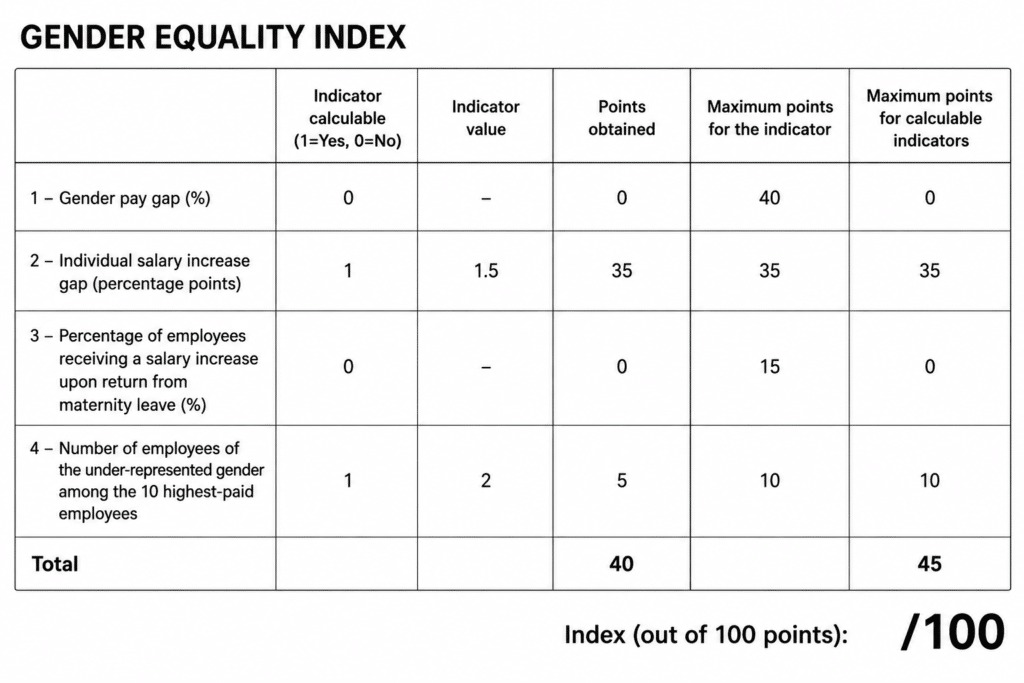
For this first table, it was not possible to calculate the index due to insufficient data. If a job category or age group comprises fewer than 3 men or 3 women, the EgaPro indicator cannot be calculated for statistical reasons. Example: if a company has 2 women and 5 men in a given category, the pay gap between these individuals could vary widely and may not be representative of genuine systemic inequality.

Gaps in pay, pay rises and promotions between women and men
Here again, the pay gap index could not be calculated, and some fields have been left blank. There are several reasons for this:
- If all employees in the same category have exactly the same salary, the gap is zero, and this may sometimes be indicated as ‘cannot be calculated’.
- If a category contains only men or only women, it is impossible to compare pay gaps.

Pay rises for female employees following maternity leave
Iagona, like many other companies, may not be affected by all the criteria in the index. For example, if no female employee returned from maternity leave during the year, the indicator for pay rises following maternity leave will remain blank.
The same applies to gender parity among the 10 highest earners. The short length of service and a late appointment to the executive committee explain the imbalance in these statistics.
Action plan
Taking all this data into account, Iagona has drawn up a clear and achievable action plan with reasonable deadlines. Specifically:
- Improve data collection and reporting.
- Reviewing pay scales to avoid unjustified inequalities.
- Continuing our efforts to establish clear and harmonised pay structures by role and level of experience.
- Encouraging women’s access to leadership roles
- Ensuring that all female employees receive a pay rise upon their return from maternity leave
At Iagona, we are committed to improving the gender equality index through a proactive, transparent and fair HR policy. By identifying areas for improvement and implementing concrete corrective measures, a company can not only improve its score, but also enhance its appeal and strengthen its CSR commitment!